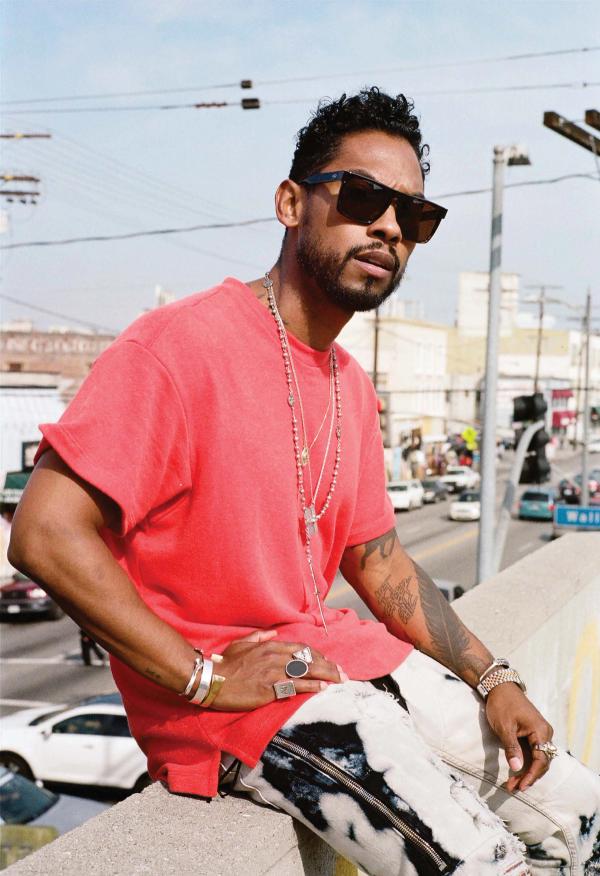
Sex jam connoisseur Miguel’s new album might be called Wildheart, but underneath lurks a proper softie. He’s even a One Direction fan, FFS.
Like many greats who came before him — Prince, D’Angelo, Usher, Basshunter — Miguel is an artist so distinctive, gifted, and sexually supercharged that he has zero need for anything as lame and boner-killing as a surname. At 29 years old, the half-Mexican, half-African American, wholly gorgeous LA native has just put out Wildheart, his third and most accomplished album yet.
Miguel’s career, much like — permit me to speculate — his style of lovemaking, has been a long, industrious, slow-burning ascent to glory. He first started releasing music at just 15, worked hard for a decade but got a bit dicked around and only hit it big in 2010, when his debut album All I Want Is You dropped and very leisurely went on to sell nearly half a million copies. As did 2012’s amazing follow-up Kaleidoscope Dream, actually.
Miguel also wrote and featured on #Beautiful — Mariah Carey’s way-best song in yonks — and penned the fanny-poppingly saucy masterpiece Rocket on Beyoncé’s last album. Renowned for being the go-to guy for sex jams, the weird thing about Miguel is that he’s also a really, really nice guy — unlike your garden-variety sex-jam guy (shout out to R. Kelly). I went to meet him at a posh London hotel and he was polite to a fault, drank Irish coffee, a beer, and then a tequila, and was basically just adorable.
BEAT: Do you feel like now is a good time to be making music?
Miguel: Fuck yeah. I think it’s always a good time to make music, man. It’s righteous.
BEAT: How do you think the industry’s changed in the 15 years you’ve been in it?
Miguel: Here’s the thing — it’s all about keeping people’s attention now. It’s not about doing anything great, or doing anything good or quality. It’s like — are you keeping people’s attention? Someone who makes shit music, if they have some controversy, will probably outsell the person with great music.
Now, it’s like so much great shit gets overlooked because everyone’s attention’s everywhere — we’re being bombarded with information all of the time. We’re just being pulled in all kinds of directions. It’s no longer just about fucking making great music. How do you get people’s attention? And there are so many different ways now. For me, it’s not antics.
BEAT: It’s never really been much about antics with you, has it? You’ve had this long slog and these slow-burning, eventually huge records.
Miguel: I’m running like a marathon here; I’m not trying to be a sprinter. I want to keep doing my shit for a long time, you know? I make music like I’m running a marathon. I’ve got long-range goals, man.
Even the songs I put out — it’s always been on my terms, which is amazing. There’s not too many artists that can really say that, and I’ve been blessed to have a major label who believe in my vision, and they’ve kind of let me do what the fuck I want. I mean, look at Adorn — that’s a slow-burning record. And the same with [new song] Coffee.
Coffee is one of those records that, like, people might not click with it right away, but that, like, third listen — it’s gonna sink in. I hope, anyway. I’m keeping my fingers crossed that it does really well. Maybe I’m an acquired taste, I don’t know.
All I Want Is You — you listen to Girl With a Tattoo — that song was a jump-off for The Weeknd. The sound of it is, like, the jump-off point for that shit. There is no Frank Ocean, there is no The Weeknd, without All I Want Is You. And I’m not saying they wouldn’t have made it, I’m just saying there was no audience for that shit before All I Want Is You. The audience wasn’t really ready.
That album, for R&B, it opened a lot of minds to something new. It’s just building upon. And that’s what we’re supposed to do. It’s like — there would be no All I Want Is You without Cherry Blue Skies by Robin Thicke, or without the first N.E.R.D record. There was no room for me without those parts of the puzzle.
BEAT: So is it always cool with you if people use your sound as a jump-off?
Miguel: So like, with Nick Jonas, that’s what he’s supposed to be doing — he’s supposed to be taking something and building upon it. What I do have a problem with, though, is the fact that had I done that song Jealous, they would’ve never worked it at pop radio. It would’ve gone “urban,” and then they would’ve waited for it to build, and then try to take it to pop radio.
That’s my real issue. Because of my ethnicity, I’m not given the same consideration or acceptance in these avenues of promotion. It’s not equal. It’s like Adorn — that song was very much worked like that. They let it bubble, it went to urban, then it went to pop, and by the time it got there, the label — and excuse me, but real shit — they didn’t jump behind it in time. So it kind of fizzled out. Even though it lasted on radio for fucking ever.
But then you get certain artists who, I’m sorry, are not Black, but do some shit like that song and they get this huge pass.
BEAT: It’s like — great song, shame how it’s kind of an example of systemic racism.
Miguel: On some real shit, that’s how it fucking goes. A musician like me has to jump through a lot of hoops to fucking get there, you know?
The crazy part is that it becomes not about the music. It’s like — why do I have to prove so much just to be put in front of a broader pop audience? It’s just weird. It’s a very subtle way of programming. Urban music will be taken and built upon, and the sound that started as an urban sound will go to pop music — but not the musicians that started it. They won’t go, just the sound.
And the sound will be adopted by pop artists who are… not, like, ethnic. It has nothing to do with music, it has to do with race, and with social programming. It’s fucked up.
BEAT: It is fucked up. Are you trying to move in a poppier direction yourself, do you think?
Miguel: Listen, I write and produce because I need to. It’s therapeutic for me, and I would do it regardless. And I know that because I was doing it before. It wasn’t for money, or anything else. It was that I needed it.
So I create for myself, but that doesn’t fucking change the fact that I want people to hear the music. I want people to discover me as a musician, as a person. I want my music to touch people; I want it to be a part of their lives.
That’s what, if anything, you’re hearing — it’s my instinct to do what the fuck I feel. I don’t know if that means it’s “poppier,” or whatever that means. But if it’s a question of popularity, then fuck yeah, I want this shit to be big. I want the world to hear this, man! I’m not here for just one or two people.
I believe my story matters. Everyone goes through a lot of the shit that I’ve been through. And it’s all about identity, and not conforming, not accepting the programming — it’s about transcending, playing the long fucking game.
It’s about the marathon, man. What the fuck else?